

Olalla Consulting
Process engineering
Formulation Insights
Processing O/W Emulsions: Why Distribution Matters More Than Size

By Carmen M. Lerga BSc (Hon) MRSC, MSCS, MIFSCC, for Olalla Consulting
In emulsion development, droplet size is often treated as the primary indicator of quality. Specifications are set around a target mean value, and processing decisions are made to achieve it. Yet experience and interfacial science both show that this focus is incomplete. What determines long term stability, sensory behaviour and robustness during scale up is not the average droplet size, but the distribution of droplet sizes created during processing.
Emulsions are metastable systems whose fate is determined by interfacial forces, droplet interactions and gravitational separation. Processing defines how droplets are formed, how often they collide, and how uniformly they experience shear. These factors collectively determine droplet size distribution, and it is this distribution that governs coalescence frequency, creaming rate and the rate of destabilisation over time.
Droplet formation is a balance of forces, not a single event
Creating an oil in water emulsion requires work. Energy is input through mixing or shear to generate new interfacial area. The work required is proportional to interfacial tension and the increase in surface area created. Surfactants reduce the interfacial tension, lowering the energy needed, but they do not eliminate the fundamental thermodynamic drive toward separation.
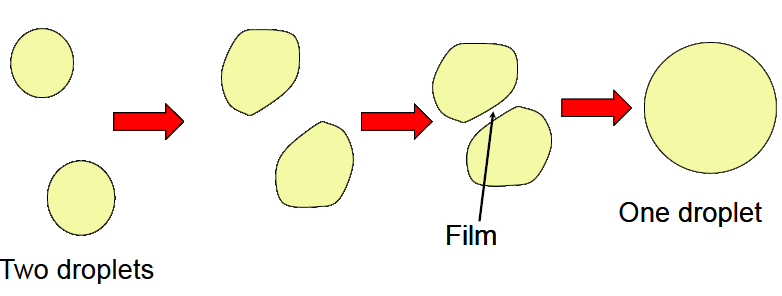
During processing, droplets are continuously broken and reformed. Breakup occurs when disruptive forces exceed the restoring forces associated with interfacial tension. Coalescence occurs when droplets collide and the interfacial film fails. Processing therefore does not create a fixed droplet population. It creates a dynamic balance between breakup and coalescence.
This balance is sensitive to how shear is applied. It is not enough to know how intense the shear is at a single point. What matters is how uniformly droplets are exposed to that shear over time.
Why average droplet size is misleading
A mean droplet size can hide significant instability risk. Two emulsions with the same average size may behave very differently if their size distributions differ.
A narrow distribution implies that most droplets experience similar shear histories and have similar interfacial coverage. A broad distribution implies that some droplets are under processed while others are over processed. Large droplets cream or sediment more rapidly and act as sinks for coalescence. Very small droplets may be more stable kinetically, but they increase interfacial area and place greater demand on surfactant availability.
Polydispersity is a key contributor to instability. Broad distributions increase the probability of droplet interactions that lead to coalescence and Ostwald ripening. Larger droplets grow at the expense of smaller ones, especially when the dispersed phase has even slight solubility in the continuous phase.
In practice, emulsions fail not because the average droplet is too large, but because a fraction of the population sits in an unstable size range.
Shear rate versus shear force
Processing discussions often confuse shear rate with shear force. Shear rate describes how fast layers of fluid move relative to each other. Shear force or shear stress describes the force applied per unit area.
Droplet breakup depends on the balance between shear stress and interfacial tension. High shear rates do not guarantee effective breakup if the shear stress experienced by the droplet is insufficient or uneven. Conversely, excessive shear stress can lead to over processing, generating heat, damaging interfacial films and increasing coalescence immediately after breakup.
Different mixers generate very different flow fields. Batch mixers create regions of high shear near the impeller and low shear elsewhere. Inline systems create more controlled and repeatable shear environments. The key distinction is not peak shear, but shear exposure uniformity.
Residence time and shear exposure uniformity
Residence time describes how long material spends under shear. In batch systems, residence time distribution is inherently broad. Some droplets circulate repeatedly through high shear zones, while others remain in low energy regions. This creates a wide droplet size distribution even when average energy input appears sufficient.
Inline systems reduce this variability by forcing all material through defined shear zones. Residence time distribution is narrower, and shear exposure is more uniform. This leads directly to narrower droplet size distributions.
Processing history matters as much as formulation. Two emulsions processed at the same nominal energy input can differ dramatically in stability depending on how that energy is distributed in space and time.
Coalescence frequency and collision dynamics
Droplets collide continuously due to Brownian motion, flow induced motion and gravitational effects. The frequency of collision increases with droplet concentration and decreases as viscosity increases. However, collision alone does not cause coalescence. Coalescence occurs when the interfacial film cannot resist deformation during contact.
Processing increases collision frequency by increasing turbulence and reducing droplet separation distances. If surfactant adsorption and film elasticity are insufficient, freshly formed droplets merge almost immediately after breakup. This is why some emulsions show no net reduction in droplet size despite high shear input.
A narrow droplet size distribution reduces coalescence frequency because droplets move more uniformly and experience similar hydrodynamic forces. Broad distributions increase differential motion, increasing collision probability between dissimilar sized droplets.
Batch versus inline challenges
Batch emulsification is attractive for flexibility, but it presents inherent challenges for droplet size control. Flow patterns are complex, and dead zones are difficult to eliminate. As scale increases, geometric similarity does not guarantee similar flow behaviour. Droplet size distributions often broaden during scale up even when impeller speed is increased.
Inline systems decouple shear generation from vessel geometry. Droplet formation occurs within defined rotor stator or multi-stage zones, and scale up is achieved by controlling flow rate and shear conditions rather than vessel size.
Processing choice influences not only droplet size but also droplet history. Uniform exposure leads to predictable distributions, which in turn lead to predictable stability.
Why distribution controls creaming and separation
Creaming rate is governed by Stokes law, which shows that separation velocity increases with the square of droplet radius and decreases with continuous phase viscosity. A small fraction of large droplets dominates creaming behaviour. Even if most droplets are small, a tail of larger droplets will rise rapidly and destabilise the emulsion.
Reducing average size does not eliminate this problem if the distribution remains broad. Narrowing the distribution is far more effective at slowing separation than pushing the mean size marginally lower.
This is why emulsions that look identical immediately after processing can behave very differently on storage. One contains a hidden population of unstable droplets.
Processing as an amplifier of interfacial design
Processing does not create stability. It amplifies the stability built into the interface. When surfactant systems adsorb rapidly, form elastic films and resist coalescence, processing refines droplet size distribution efficiently. When interfacial design is weak, processing accelerates failure by increasing collision frequency and film stress.
Processing and formulation cannot be separated. Droplet size distribution is the fingerprint of how well these two domains have been aligned.
Implications for development and scale up
Focusing on droplet size distribution changes how emulsions are developed. It shifts attention from peak shear to shear uniformity, from impeller speed to residence time distribution, and from equipment selection to process architecture.
It also explains why some emulsions scale smoothly while others fail unpredictably. The difference lies in how reproducible the droplet formation pathway is, not in how aggressively the system is mixed.
Conclusion
Droplet size distribution is the most meaningful processing outcome in oil in water emulsions. It reflects how shear is applied, how droplets collide, and how effectively the interfacial film resists coalescence. Average droplet size alone cannot capture these dynamics.
By designing processes that deliver uniform shear exposure and narrow residence time distributions, formulators and engineers can produce emulsions that are more stable, more scalable and less dependent on excessive energy input. This perspective forms the bridge between interfacial science and modern inline processing strategies.
I will break down droplet formation dynamics, processing pathways and scale up implications in detail during my technical session at CHEMUK on 20 May, Stage 4 at 15:45.
🔗 Learn more at Olalla Consulting
For support with emulsion processing, droplet size optimisation and scale up strategy, visit:
https://www.olallaconsulting.com