
Mixing is often described as the most universal of all processing operations. In cosmetics and toiletries, it is not simply a mechanical step, it is the heartbeat of formulation. Whether we are blending delicate fragrances into bath products, dispersing pigments into foundations, or creating stable emulsions for creams and lotions, the way we mix determines the quality, performance, and even the regulatory compliance of the final product.
With three decades of experience in formulation and regulatory consultancy, I’ve seen first-hand how mixing can make or break a product. Let’s explore the fundamentals of fluid mixing, the equipment behind it, and the specialized techniques that allow us to handle everything from low-viscosity liquids to stubbornly viscous pastes.
Understanding Fluid Mixing: Laminar vs. Turbulent Flow
At its core, mixing is about moving molecules into intimate contact. In a pipe or vessel, fluids can exhibit laminar flow, where particles move in neat, parallel lines, or turbulent flow, where eddies and currents create chaotic, yet highly effective mixing.
Laminar flow relies on Brownian motion, which is painfully slow for industrial purposes. Turbulence, on the other hand, is the formulator’s ally. By increasing flow speed, adjacent layers interact, shear forces develop, and eddy currents form. This turbulence dramatically accelerates mixing, ensuring homogeneity in minutes rather than hours.


The Role of Mixing Equipment
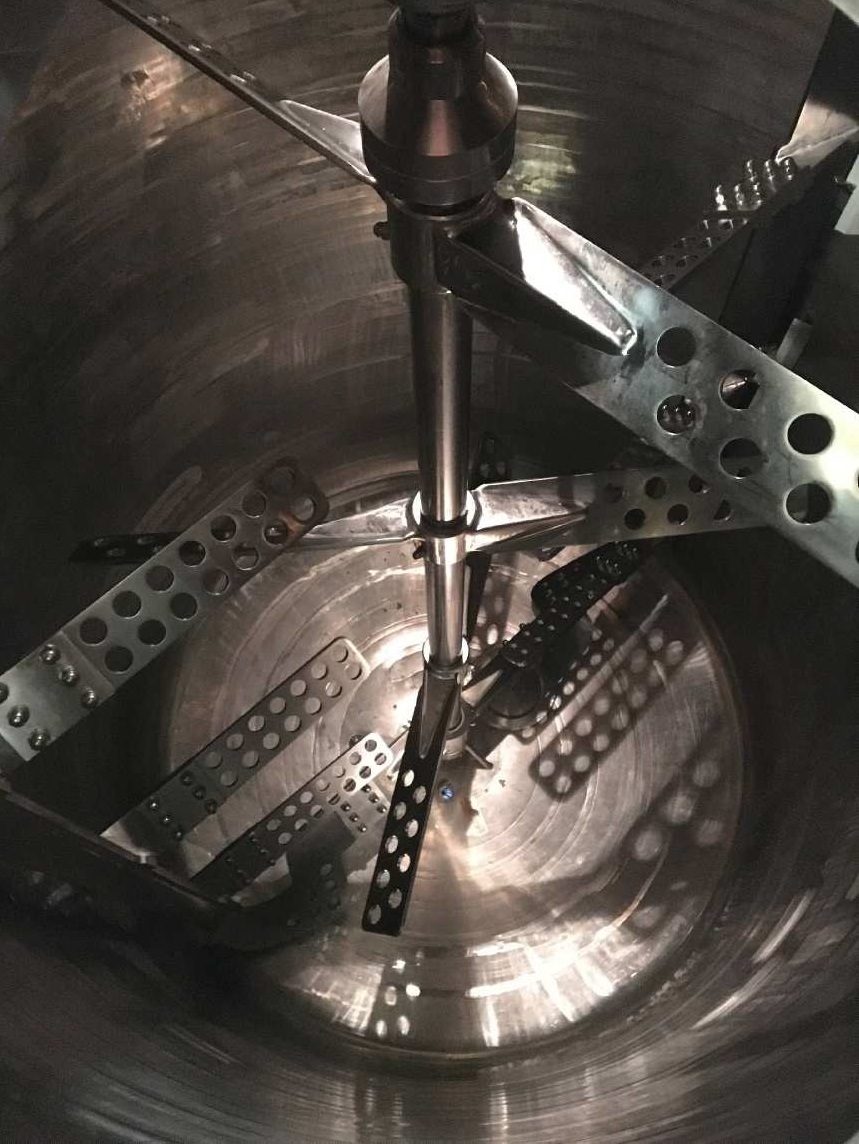
On a production scale, the vessel and impeller design dictate the flow pattern. Factors such as vessel shape, impeller position, and the presence of baffles all influence whether we achieve tangential, radial, or axial flow.
- Tangential flow: Parallel to the impeller, useful mainly for air removal.
- Radial flow: Outward discharge with partial turbulence, often seen in turbine mixers.
- Axial flow: Parallel to the axis of rotation, delivering vertical circulation. This is the gold standard for efficient mixing, though it requires careful vessel design and baffling.
Impeller Designs: Paddles, Propellers, and Turbines
The impeller is the heart of any mixing system. Its job is to create circulation and entrainment, pulling streams of product back into the bulk.
- Paddle mixers: Simple and inexpensive, but limited to low-viscosity liquids. Often used for stirring oil phases.
- Propeller mixers: With pitched blades, they generate strong circulation and turbulence, ideal for low-viscosity products like foam baths or fragrances.
- Turbine mixers: Versatile and powerful, turbines handle a wide range of viscosities. They are indispensable for emulsions, creams, and lotions.
Each design has its place, but the choice must align with the product’s rheology and desired outcome.
Baffles and Impeller Placement: Avoiding the Vortex Trap
Without stationary fittings, impellers create vortices, swirls that entrap air and reduce turbulence. Baffles, mounted vertically inside the vessel, break up these swirls and promote vertical currents.
Placement matters too. A centrally mounted mixer often creates a vortex, while an eccentric mount increases turbulence and avoids air entrapment. For high-performance dispersion, turbines paired with stator rings are particularly effective, creating localized shear zones that break down immiscible phases into fine droplets.
Vessel Design: Engineering for Efficiency
The vessel itself must be designed to maximize turbulence and avoid dead spots. Best practice includes:
- Vertical cylindrical tanks with convex bottoms.
- Smooth finishes to prevent material trapping.
- Careful positioning of feed pipes to avoid stagnant zones.
- Ratios of impeller-to-tank diameter between 1:3 and 1:4, and tank diameter-to-height between 1:3 and 1:6.
These seemingly small design choices can dramatically affect batch consistency and scale-up success.
Mixing High-Viscosity Liquids: Beyond Turbulence
When viscosity rises, think mascara, soap, or heavy creams, turbulence alone is insufficient. Energy input risks heating rather than mixing. Here, we rely on distributive mixing, a cutting and folding action akin to kneading pastry. This ensures shear is applied throughout the mass, distributing pigments, waxes, and oils evenly.
High-Shear Mixers and Dispersion Equipment
For demanding applications, high-shear devices are indispensable.
- Rotor/Stator Mixers: Exemplified by the High shear mixing design, these mixers operate at 3000–6000 rpm. Product is forced through a narrow gap between rotor and stator, generating intense shear. They are ideal for dispersing pigments in foundations and mascaras, ensuring uniform colour extension.
- Triple Roller Mills: Using three precision-machined rollers, these mills apply compression and shear to pigment pastes. Though slower than rotor/stator mixers, they excel with viscous products like soap.
- Colloid Mills: With gaps as fine as 0.001", colloid mills (stone or toothed) disperse pigments into lipstick pastes. Multiple passes ensure pigments are fully wetted and extended.
Each of these tools addresses the limitations of conventional impellers, enabling formulators to achieve the fine dispersions demanded by modern cosmetics.
Case Study: Oil-in-Water Emulsion with High Shear Homogenisation
One of the most common and technically demanding processes in cosmetics is the creation of stable oil-in-water emulsions, the backbone of creams, lotions, and many skincare formulations. Achieving uniform droplet size and preventing phase separation requires more than simple stirring; it demands controlled shear and precision mixing.
A typical process flow looks like this:
- Preparation of the water phase
The aqueous phase is loaded into the main vessel and heated to around 70°C. Any water-soluble actives, humectants, or stabilisers are dissolved at this stage. - Preparation of the oil phase
Oils, waxes, and lipophilic ingredients are melted in a separate pan, also heated to 70°C, ensuring complete liquefaction and uniformity. - Emulsification with a high shear homogeniser
Once both phases reach the same temperature, the oil phase is slowly added into the water phase under vigorous mixing. A rotor/stator homogeniser operating at 3000–6000 rpm applies intense shear, forcing the immiscible liquids through a narrow gap. This breaks the oil into fine droplets, disperses them evenly, and stabilises the emulsion. - Cooling and finishing
The emulsion is cooled under continued mixing to prevent droplet coalescence. Pigments, fragrances, or heat-sensitive actives are added during the cooling stage. Colour uniformity can be checked using a Hegman gauge, ensuring pigment dispersion meets quality standards. - Quality control
Droplet size distribution and viscosity are measured to confirm stability. Adjustments, such as fine-tuning emulsifier levels or pigment corrections, can be made before the batch is finalised.
This process demonstrates the critical role of high shear homogenisation in modern formulation. Without sufficient shear, oil droplets remain too large, leading to creaming, separation, or poor sensory feel. With the right equipment and process control, however, formulators can achieve silky, stable emulsions that meet both consumer expectations and regulatory standards.
Conclusion: Mixing as the Foundation of Innovation
Mixing may appear simple, but it is the most critical operation in cosmetic manufacturing. From the physics of flow patterns to the precision of high-shear equipment, every choice impact product performance, consumer experience, and regulatory compliance.
As formulators, we must treat mixing not as an afterthought but as a science and an art. The right vessel design, impeller selection, and shear application transform raw materials into market-leading products. And in an industry where innovation is constant, mastering mixing is the key to staying ahead.
I would like to extend my sincere gratitude to Josep Maria Siso from and the team at Vak Kimsa for their invaluable support and insights. Their expertise and collaboration have greatly enriched this exploration of mixing science and innovation in cosmetics. Thank you for being a trusted partner in advancing formulation excellence.